Category: funfair events

Fun Story, funfair events, Funfair Rides

Eyerly Aircraft Company, A Manufacturer Profile

15 May 2021

There aren’t a great deal of amusement ride manufacturers that started life building aeroplanes. The American Eyerly Aircraft CO. was initially set up to manufacturer training aids for pilots. The first was the curiously entitled ‘Whiffle Hen’, an airplane which only used two gallons of fuel per hour of flight.

The craft derived it’s name from a bird thought to be good luck that appeared in the Popeye cartoons, everyone thinks Popeye gained his strength from eating spinach, but in the early days he used to rub the whiffle hen instead.

Lee Eyerly’s dream was to make flight available to all classes, not just the rich. He was responsible for building Salem Airport, and ran a flight training school, as well as taking people up in his own plane at fairs and events.

His second great invention was the Orientator, basically and airplane fuselage suspended between what looked like a giant tuning fork. The wind from the propellor streamed across the aircraft wings and surface controls and allowed the pilot to bank climb and roll, just like in a real aircraft but without the cost and danger associated.

A few were sold (including four to the Cuban air force), but sales began to slow down. It was suggested by someone who remains unrecorded by history, that he take the device to a local funfair, or Midway as our American cousins refer to them. Allegedly he also sold rides in a real aeroplane that he flew, but soon noticed that the queue for the Orientator was far longer than for the real plane.

That lighbulb moment saw the focus of his company switch to amusement ride manufacturing. The trainer was re christened the Acroplane and was sold purely as an amusement device.

Line Of Amusement Rides

This was just the beginning. The ride was quickly followed by the Loop-O-Plane, Roll-O-Plane, Spider, Fly-O-Plane, all designed to give people a taste of what it was like to fly, just at that period in history when Aviation was beginning to take off, excuse the pun.

The Rock O Plane was invented in 1947, and the ride type still survives on many funfairs today. Some in the original style, others have been modified to create a slightly more thrilling and up to date ride.

The Octopus

Perhaps his most popular ride was the Octopus. Little seen nowadays on the modern fairground, there are still a few doing the vintage circuit at shows and rally’s, but it is considered a bit tame for the modern generation of thrill seekers.

The company continued in the business up until the mid 1980’s. Sadly in 1988 at a Florida fair, an arm on an Octopus ride snapped. The arm was suffering from metal fatigue. The crack was paint covered and unnoticed by both the ride owner and the State inspector. A 17 year old girl died from head injuries. In the wake of the lawsuit that followed, the company closed its doors in 1990.

The genesis of the Eyerly Aircraft Company was certainly unique as ride manufacturers go.

Sources;

Consumer Product Safety Commision

Eyerly Aircraft Company

Lagoon History

Event Planning, Fun Story, funfair events, Funfair Rides

The Dive Bomber, History Of an Iconic Ride

10 May 2021

Most of the early funfair rides were things like carousels, Noah’s arks and dodgems. Exciting rides, but all with a similar movement, you go around in circles. What we would call thrill rides came later, and nowadays most of the high thrill attractions have you leave the ground. One of the earliest examples of this was the Dive Bomber.

Initially created by the Eyerly Aircraft company which was formed to create equipment to help train pilots. They moved into the amusement ride arena, and gradually moved away from their original business model. Much of what they designed had an aviation feel, and the dive bomber was no exception.

Roll O Plane

Patented in 1938 by Eyerly, as the ‘Roll-O-Plane’, the ride had two cylindrical shaped cars on the end of a rotating boom. As the arm rotated the ends of the cylinders rotated to keep the riders sitting upright. The chain drive made it a particularly noisy ride, added to the usual decor of a fighter plane and it was an imposing, thrilling ride for the era.

Lusse Dive Bomber

Lusse Brothers of Blackpool (American designers) developed the ride for the UK market under licence from Eyerly. Building their first version in 1939 and the last of 25 examples in 1949. With the recent end of WWII the ride was perfectly themed for the fairgoers of that era.

One of the drawbacks was its low passenger capacity, but a number of enterprising UK showmen, joined two rides together to double this as in the Carters model above.

The rides were a high maintenance device and eventually fell out of favour, I can just remember them as a kid in the 80’s and only for a few years. Truth be told I seem to remember them having a propensity to fold up, what Elon Musk would call a RUD (rapid unscheduled disassembly). The testing regime in those days wasn’t as developed as today, with x-ray and dye penetration testing, so I think the metal was a little overstressed for the job it was doing.

The Modern Bomber

Like many things in life, the wheel turned and a new version appeared. Built by Italian manufacturer Fabbri as the Booster Maxx, this is a much bigger, much faster and carries a lot more riders (up to 16). It is also a lot more sturdily constructed with modern techniques and materials. It is easily one of the highest and fastest rides on the circuit. Bringing the same aerial thrills to new generations.

Sources;

National Fairground Archive

Catering, Event Planning, Fun Story, funfair events

Our 10 Favourite Jacket Potato Fillings

28 April 2021

Jacket spuds, baked taters, call them what you will. Definitely one of our favourite catering options. Especially as in the current quest for healthier options these are quite easy to use. We take a look at some of our most popular jacket potato filling, as well as some others available throughout the world.

1 Beans and Cheese

This one is oh so simple, and oh so delicious. Heinz beans of course with a nice mature cheddar. Not high on the excitement stakes, but easily our most requested filling. Unless we are dealing with Eastern Europeans. It seems that this isn’t a natural combination for them. And we have heard that the Yanks don’t go a bundle for it either, but looking at their cuisine we aren’t too upset by that.

2 Chilli Con Carne

Our MD’s favourite. Ground beef chilli, with plenty of peppers topped with avocado, sour cream and chives. Almost as popular with our clients, again excluding the Eastern Europeans who are worried by the word chilli, they expect it to blow your head off.

3 Tuna And Sweetcorn

Our top rated cold filling. Juicy tuna, sweetcorn all mixed in a mayonnaise base. A pinch of radish for seasoning and a little side salad. Much healthier than the usual burger and chips.

4 Vegetable Curry

This is one that the Eastern European guests actually enjoy. In fact on the recent series of jobs we did where the bulk of the staff were from that part of the world we couldn’t make it fast enough. So now we know their favourite jacket potato filling. Only mild, but with a nice range of veggie ingredients.

5 Chicken Curry

One for the carnivores this time, another fairly mild curry, but with juicy tender chicken pieces. Add a little coleslaw and a side salad and you have a nice balanced meal.

6 Bacon and Cheese

Bacon and cheese, two of our favourite things. What’s not to like. Nice smoked bacon, mature cheddar, mixed up and lightly roasted a second time to melt the cheese. Yum.

7 Prawns

Prawns in a prawn mayo sauce. Another cold topping that it healthy and delicious. Add the obligatory side salad and you have a winner. Unless of course you don’t like prawns.

8 Cottage Cheese And Pineapple

A fusion of tastes here, sweet chunks of pineapple, with lashings of cottage cheese. A milder flavour than our use mature cheddar this one is high in proteins and essential nutrients.

9 World’s Most Expensive Jacket Potato

Not one of ours, though we would be quite happy to add it to your menu if you are happy to pay the premium. This one was created by the chef at the Cary Arms in Babbacombe Devon. Most of the potato is spooned out and replaced with a mixture of creme fraiche, lemon, chives and spring onions topped by Italian Calvisius caviar. Served with balsamic roasted vine tomatoes and a glass of champagne. £40 lets you try this culinary masterpiece.

10 Sweet Jacket Potato With Roast Grape, Goats Cheese and Honey

Again not one of ours, but this in definitely on the list to try at the next event. Sweet potato with a mixture of roast grapes honey and goats cheese.

These are only a sample of what is available. If you are holding an event and require a jacket potato stall we can work with you on a customised menu just for you.

Event Planning, Fun Story, funfair events, Funfair Games

History Of Crazy Golf

24 April 2021

One of our favourite games, which is lately seeing something of a resurgence. Easily playable by both young and old, it has something for everyone. Let’s take a quick look at the history of crazy golf.

The game has various names around the world, including mini golf, midget golf, goofy golf, and putter golf. The last name probably being the most accurate as the game is basically the putting part of its parent game.

Golf proper, has a long history. Mention is made of King James II banning the game as it distracted his archers from their practise. Happily James IV decided to repeal the ban for the good reason that he liked playing the game.

There are ancient examples of a similar game being played as far back as 8th Century China, though no doubt if written history existed there may well as been cavemen who likes whacking stones around with their clubs.

Like many things there isn’t a definite ‘inventor’ of the mini golf game. Our Victorian forebears, with their great fear of mixing the genders, dedicated a putting green annex for female players at the famous St Andrews course.

Artificial courses, with obstacles began to emerge during the first part of the 20th Century. The Illustrated London News documented a course in it’s 8th June 1912 edition, called Gofstacle.

Across The Pond

In America, where else, the first mass produced mini golf courses were designed. The first of note was christened ‘Thistle Du’ anc built in Pinehurst North Carolina in 1916.

1927 saw a huge step forward when Garnet Carter created a suitable artificial green made from sand, oil, dye and cottonseed hulls that had been invented by Thomas Fairbairn, a cotton plant owner.

This allowed the game to be installed anywhere, indeed by the late 20’s there were an estimated 150 roof top courses in New York City alone. With tens of thousands across the States. At one point it’s estimated that 2 million people a day were playing the game. The course designed by Garnet was sold as a starter kit for $4500 (about $75,000 now) for which you received the obstacles, equipment and layout design.

Sadly, like many booming industries, mini golf was virtually wiped out across the States by the great depression.

On The Continent

Across the channel, the first documented course was built by a Herr Schroder in Hamburg, Germany. Being inspired from a course he played on a visit to America.

In fact like many modern trends, the game spread out from the USA. The Norman brothers returned to Sweden from there, and promptly formed the company of Norman och Norman Miniatyrgolf, selling a standardised course across Sweden.

The Swedish Minigolf Federation was founded in 1937 and remains the oldest minigolf organisation in the World, with national championships being played since 1939.

The Americans of course commercialised the game, with the first national competition being held in 1930, with a top prize of $2000 equivalent to around $30,000 today.

Mini Golf Obstacles

By the end of the 30’s the familiar obstacles such as windmills and buildings were being added to the game, making it much more like what we consider crazy golf to be nowadays. Many of these were introduced by Joseph and Robert Taylor, two brothers from New York. Many customers and competitors asked if they would build obstacles for them. In the early 1940’s the brothers formed a company to supply the industry.

Even the U.S. military bought from them. Shipping a number of prefabricated courses overseas during the Korean and Vietnam wars. For the troops to use during rest and relaxation periods.

Surface Material

Courses in Europe and the U.K. tended to use tennis field sand bordered by wooden frames as a playing surface. The Americans used the newly developed felt materiel. Being far superior due to its ability to allow water to pass through. Meaning it could be used in inclement weather.

Towards the end of the 1950’s virtually all suppliers carried Taylor Brothers obstacles making them an industry standard. Throughout the 50’s these had been developed to include obstacles with spinning blades and such that required not only accuracy but split second timing.

Modern Mini Golf

Nowadays the game is governed by the World Minigolf Federation, based in Goteborg Sweden. Organising World Championships for everything from kids through to elite players.

There are a number of standardised courses approved by them allowing comparisons for players around the world. The current world record for one round of 18 hole minigolf is 18 strokes. More than a thousand players achieving this score. It should be noted that virtually all of these are on a playing surface made from eternite a fibre cement product. The more popular felt courses seem to be more difficult to play with far fewer players managing a perfect score.

Some Crazy, Crazy Golf Courses

Ahlgrim Funeral Home

Below a Chicago Funeral home is a course designed to allow mourners to take their minds off bereavement. Along with arcade machines and videogames.

New Brighton Championship Course

This course contains replicas of a number of different famous championship holes from the Island Green 17th at TPC Sawgrass or the 18th at St Andrews.

Glow In The Dark Golf

A course in the Netherlands came up with the wacky idea for a glowing golf course. It also has the added quirk of being an adventure story, as completing the holes give you the clues you need to rescue a kidnapped singer.

Holy Crazy Golf Course

This one not only improves your golf score, but saves your soul. Designed around stories from the bible with holes such as Jonah and whale, or Moses and Mount Sinai. You can visit it at the Lexington Centre in Kentucky U.S.A. (where else).

Mayday Golf

Another wacky themed course. You are a survivor of an airplane crash. You use your rescued golf clubs to put your way through various survival scenarios to reach the rescue helicopter at the end. See it at Myrtle Beach South Carolina.

Leisureland Golf

This entry if from the artist Doug Fishbone. He wanted to draw attention to the plight of migrants, refugees and police brutality. So he pulled together a course of political statements.

The history of crazy golf is littered with examples of weird and wacky golf themes. Really the game is a blank canvas and you can have anything you like.

Sources;

Crazy Golf Museum

Mini Golf Creations

Event Planning, Fun Story, funfair events, Funfair Rides

The Waltzer, History Of An Iconic Ride

10 April 2021

One of the mainstays for any British funfair is the Waltzer. Indeed so popular is this particular ride that you will struggle to find any but the smallest funfairs without one.

Similar in style to the Noah’s Ark ride, i.e., a platform that rotates at high speed and undulates over a number of hills to give an up and down motion. The difference is the ark originally had various animals to sit on, then evolved to have motorbikes, probably around the time that motorbikes became popular with young people. This led in some places to them becoming more popularly known as speedways. As most early rides were these tended to be ornately decorated.

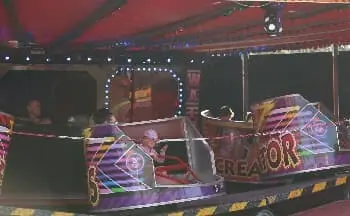
The waltzer by contrast has tub shaped cars, that are attached by either a slew ring or a pivot point to the platform. As the ride rotated, the riders all sat at one end of the car would unbalance it and it would begin to spin. The attendants on the ride would walk the platform as it rotated spinning the cars by hand to make them faster. With attractive young ladies tending to be spun the most.

Waltzer car
Waltzer car

Early History

The very first evidence we have for the ride, is a 1920’s model built by one Dennis Jeffries of Congleton. Posterity records the very first passengers as being his nieces Phyllis and Dolly Booth, nothing like using family as Guinee pigs. A tradition which continues today, a few years back a relative building his own ghost train had put the first car together, but wasn’t sure if the gearing was correct. He put his old dad in as a crash test dummy and set it in motion. The car accelerated along the track like an exocet missile, jumped the rails at the first corner and set off into infinity and beyond. Luckily said dad fell off at this point. No amount of cajoling could convince him to try the mark two car.

Maxwell And Sons

The sadly now defunct Scottish firm of Maxwell and Sons, based in Musselburgh, became perhaps the best known manufacturer of the ride in the UK producing some 59 examples of the ride. Waltzers tended to have ten cars, though as the ark/speedway fell out of fashion a number of these were converted to waltzers so there are both nine and eleven car examples.

H.P. Jacksons

The biggest rival to Maxwells was the Congleton based firm of Jackson’s who produced 29 rides. They kept going a little longer than Maxwells producing their last ride in 1992. (Maxwells were out of business by 1983)

A number of other firms produced waltzers, but only in very small numbers.

Fairtrade Services

Waltzers were always an extremely labour intensive ride to set up and derig. A handful of examples were converted to pack on an artic load to reduce the set up time. A showmen by the name of Robert Porter, who was experienced in refurbishing and repairing waltzers. Took this a step further with a design for a new ride, made from the start to be a more compact travel load and quicker set up.

Under the brand of Fairtrade Services he has now produced 21 examples. They are on track to surpass Jackson’s as the second most prolific manufacturer.

One particularly striking example of a ‘Porter Waltzer’ as they are more commonly referred to, is the example above. Built for the Norwegian firm of Lund’s Tivoli. With Aasmund Lund at the helm, the firm commissioned this ride. With it’s stunning fireball theme, around the back of the ride are numerous led screens that provide a fire effect.

It is unusual that although the ride is one of the most popular in the UK, it is seldom seen on the continent. Raymond Codona Jnr travelled his Hell Raiser waltzer in Holland for a number of seasons. Very successfully, but you find few native examples.

Tilt-A-Whirl

Across the pond Herbert Sellner invented a similar ride called the Tilt-A-Whirl in 1926. Similar in motion to the waltzer this type only has seven cars, but otherwise works in much the same way.

The most noticeable difference, is that the waltzer has a roof and is an enclosed ride. Add in the sound and lighting systems and they are much like a portable nighclub. The tilt a whirl by contrast is an open topped ride. To be honest looks very much like an home made waltzer.

The Waltzers

The waltzer is an enduring icon of the British fairground scene. One change to its detriment is are the current health and safety laws. Waltzers were renowned for having the gangway around the edge of the ride packed with people. It truly was a social event, with many a couple meeting on the waltzers (Kevin Keegan the England football star was one, meeting his wife on Dowses waltzer at Scunthorpe). Sadly young people nowadays aren’t considered responsible enough to stand on he gangway a few feet from the spinning platform so now the ride is closed off whilst it is in motion.

Sources;

Fairground Heritage

National Fairground and Circus Archive

Wikipedia Waltzers Originally Had 10 Cars