Category: funfair events

Event Planning, Fun Story, funfair events, Funfair Rides

The Carousel, History Of An Iconic Ride

11 March 2021

Many of the rides still travelling on funfairs have been around for decades, in some cases over 100 years. Others are relatively new designs, but have still achieved iconic status. One such ride is the carousel, the first of the rides we are going to take an in depth look at.

Early History

Much of Europe and the Middle East have a long history of jousting. Knights would gallop in circles whilst tossing balls to each other, a demonstration of their skill and horsemanship. The actual word carousel takes its origins from the Italian Carosella meaning little battle, which was an exercise used by Arabian and Turkish horsemen to prepare for actual battle. essentially a training mechanism to prepare and strengthen the riders sword play.

Eventually as medieval jousting gave way to the cavelry era, this was replaced with demonstrations and spectacles that had the rides spearing suspended rings.

Eventually even the commoners began to play the game, and rudimentary carousels began to be set up at fairgrounds across Europe. An early make believe carousel with wooden horses was set up in Paris, at the Place Du Carousel for children.

The forerunner to the modern carousel, was what in the UK is termed a dobbie set. Much like a carousel, but with one important feature lacking. The horses didn’t have an up and down motion. They were either suspended on poles, or fastened to the platform, and though they would rotate in the same manner, they lacked the galloping. They also tended to be much smaller that the rides we are used.

Then Came Steam

The first of the two breakthroughs that led to the ride we all know and love today came around 1861. Invented by a gentleman called Thomas Bradshaw, who built a ride that was powered by a steam engine. This allowed a much bigger structure, with crucially more riders. One newspaper of the time remarking that it moved with such impetuosity that the wonder was the riders not being shot off like cannonballs.

Then Came Frederick Savage

The final piece of the puzzle came from an English engineer. Frederick Savage was a builder of agricultural machinery. Who, for reasons unknown decided to branch out into the design and production of funfair rides.

By the 70’s (the 1870’s that is), he was exporting funfair attractions all over the world. He experimented with various designs, and at one point came up with the ‘Sea-On-Land’ a nautical themed attraction, that used an offset crank system to pitch and roll the boats on the roundabout.

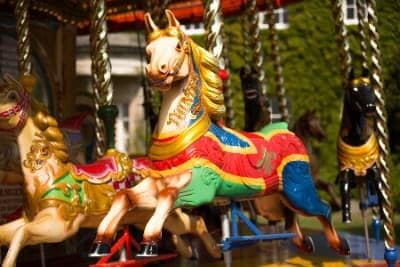
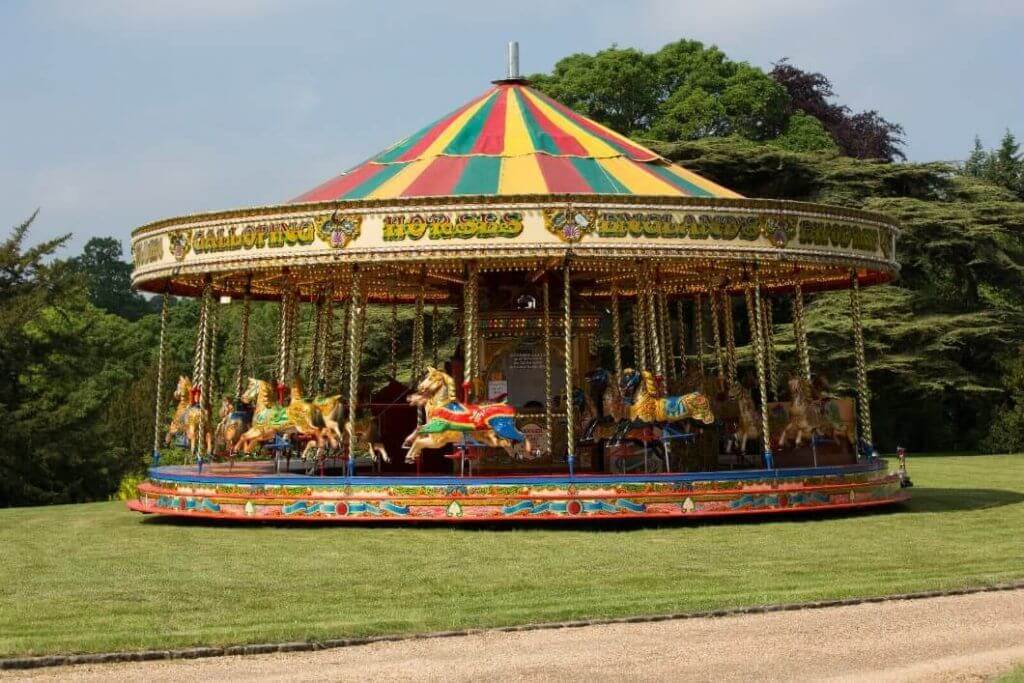
When he took this new idea and married it to a steam powered carousel to give the horses the motion they lacked, he created what he called the platform gallopers. Steam powered organs were often installed into the centre of the ride to give it the classic carousel design, that isn’t that much changed today.

Our American Cousins

Across the pond, it was immigrants that developed the Carousel. Including Charles W.F. Dare from England and Gustav Dentzel of Germany. A number of differnent manufacturers appeared, all with differing styles, Looff had reaslitcally painted saddles, whilst the Coney Island style had elaborate jeweled saddles from the likes of Dentzel, Herschell’s and Spillman’s often having no saddles at all. Their machines tended to be large and elaborate, highly decorated affairs.

One curiosity is the direction of travel. In the U.K., a carousel, in common with most rotating rides moves in a clock wise motion. Whereas in the States and Europe it goes the opposite way.
White Victorian Carousel Horse
Victorian Carousel Hire
Catering, Event Planning, Fun Story, funfair events

Hey, Do You Know This About French Fries

9 March 2021

The humble potato. Cultivated in the America’s around 10,000 years ago, then brought to Europe in the 16th century by the Spanish. One of the most versatile foods available. Can be served boiled, roasted, mashed, or as is the case here, as French Fries.

In these fair isles we more commonly refer to them as chips, rather that the Yankee ‘fries’. This evidently dates back to 1769 and actually referred to fruit chips. To further confuse the matter, our American brethren, call crisps, chips.

They can be crisp, or soft, indeed the British traditionally eat them soggy with vinegar and wrapped in old newspaper.

The Variety Of Potato We Use

The idaho Russet Burbank is commonly used by fast food chains. Developed by Luther Burbank, a plant breeder. Initially unpopular, growers cottoned on to the fact that it produced large potatoes that could be marketed as baking potatoes. Then the explosion of fast food chains further increased its use.

The Best Fries Are Fried Twice

The potato is cut into strips. Traditionally it was peeled first, but now is often enjoyed unpeeled as this retains beneficial vitamins. Soaking in water removes the surface starch. Missing this step will result in a soggy, mushy chip due to the starch blocking the evaporation of moisture from the vegetable.

The best results are obtained using the two bath method. First they are blanched by being submerged in hot fat at 160C. Then briefly fried in hotter fat at 190C, to crisp them. They are drained ,salted and served.

Vegetable oil is used for frying, though originally beef suet or as one fabulous chip shop in Yorkshire still uses, beef dripping. Indeed if you are ever in the vicinity of Sturgate airfield it is well worth a visit. In fact, you can fly into Sturgate airstrip and visit the chippie.

Five Guys just had to be different, they fry theirs in peanut oil.

French Fries Might Not Be French

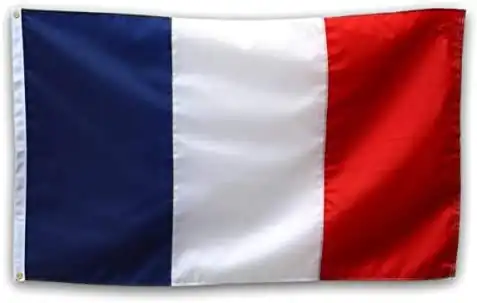
The French, Belgians and Spanish all claim the invention of French Fries. Though no one really knows the truth. The French claim is that they originated from street vendors in the vicinity of the Pont Neuf bridge in Paris.

The Spanish were the first to bring them into Europe so claim they also invented chips.

And the Belgian claim is that they are quite close to France and people confused their invention with a French one. In fact, they are so upset by France claiming them, that they have petitioned UNESCO to claim official heritage status for ‘their’ dish of fries and mayo.

French Flag
French Flag

Thomas Jefferson Introduced Them To America

President Jefferson worked abroad as American Minister to France. Whilst their he sampled the delights of the culinary masterpiece. When he returned home and became President, his chef James Hemings continued to cook them for him.

A Typical American Eats 30 Pounds A Year In Fries

Think about that. That’s the weight of a small child. Your gonna need a hell of a lot of ketchup to go with that. Look guys we all love fries, but 30lb seriously?

Charles Dickens Wrote About Fries

Yup, one of history’s most celebrated authors actually alluded to fries in his novel, ‘A Tale Of Two Cities’. He called them husky chips of potato, fried with some reluctant drops of oil. TBF he also wrote about dozens of breakfast foods, dinners and pints of beer. Turns out he was a bit of a foodie at heart.

Fries Are Little Kids Favourite Vegetables.

A study by the Journal of Nutrition found they were the most commonly consumed vegetable for young children. A published study by the way. I mean, you needed to waste ink and paper to discover this, come on guys. A Sunderland fan who wasn’t in possession of the communal brain cell could have told you this without wasting energy on research.

Kid Eating Fries
Kid Eating Fries

They Are Actually Healthier Than You Think

No, we aren’t saying they are healthy compared to say a salad or something. But being a potato, they actually include vitamins B6,C, magnesium and iron. So they do have some nutritional benefits.

Congress Changed The Name To Freedom Fries.

When the operation to invade Iraq was being planned. France refused to join in. Probably on account of not being allowed to be in charge.

Jed Babbin, a former deputy undersecretary of defense stated that going to war without the French, would be like going hunting without an accordian. You are just leaving a lot of noisy useless baggage behind!

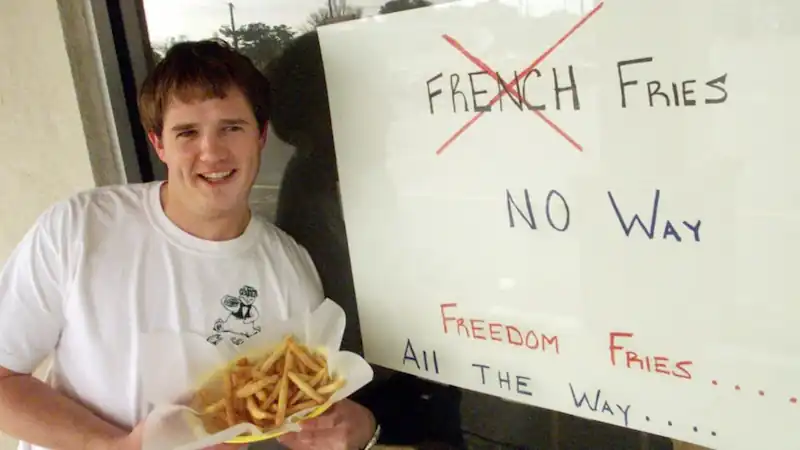
To further underscore their displeasure. Congress changed the name on their in house menu’s to freedom fries, and dropped the French from the name. They would have liked to have rolled this change out across the States, but as the war fell out of favour, so did the name.

It was quietly changed back in 2006.

Freedom Fries
Freedom Fries

Burn Those Calories Baby

A medium portion of McDonalds French fries would require 47 minutes of high impact aerobics or 58 minutes of cycling to burn off. One ‘professor’ suggested that a proper portion of fries should be around six. Really, just six fries, just goes to prove what planet professors are living on.

For the 224 calories you are consuming you could also have 1.4kg of celery, 385g of apples, 588g of broccoli, 102g of canned tuna or 3 boiled eggs or a 51g piece of cheese.

Nah, we’ll stick with the fries.

Thick Or Thin

Traditional British ‘chips’ or what some called steak cut fries are actually a healthier option compared to the skinny fries typical of a fast food joint. The greater the surface area of a chip, the more oil is absorbed. So weight for weight, skinny fries have much greater surface area, therefore they will be higher in calories and fat.

Fries Aren’t Just Fries

There are actually something like about 18 different types of fries. From the thick cut steak chips, to curly fries, tornado fries, waffle fries and more.

Some People Put Sugar On Their Fries

Different nationalities eat their fries in different ways. In Vietnam they sprinkle them with sugar. The Belgians and Dutch slather mayo on. Americans love their Ketchup. The South Korean’s add honey and butter (really).

Personally we think nothing beats good old salt and vinegar.

Fries Have Been Tested For Use In Space

E.S.A., the European Space Agency teamed up with Greek researchers to test making fries in a centrifuge. What they discovered was that as gravity increases, the fries get crisper. In fact perfect fries would need gravity three times that of Earth.

Sadly the microgravity found in space means they would be a soggy mess, so no fries on that trip to Mars unfortunately.

If you are planning an event, we can offer you both French fries, and dirty fries. Or even spiral fries.

Resources;

Freedom Fries

Fries In Space

Event Planning, funfair events, Funfair Rides

PWS Rides, A Manufacturer Profile

7 March 2021

Another of our profiles of amusement manufacturers. This one is actually UK based, and both manufactures and refurbishes a range of adult rides. In terms of sales and range of products it is more restricted than many of the big Italian and Dutch marquees. It is however highly regarded within the industry, especially the home market.

The company takes its name from the founder, Perrin William Stevens, who during the 1970’s built and sold rides around Europe, and even as far as the States.

Nowadays they have factories in both England and Poland, and as well as building new rides, they also refurbish older rides and equipment. Their specialities are Twists, Dodgems, Extremes and the Frogs.

PWS Sizzler Twist

One of its mainstays is the sizzler twist. This is much the same ride as the Eli Bridge ‘Scrambler’, but the PWS version is a more hi tech take on its American cousin. It is also designed to fold up onto its transport trailer, so is bigger, and more highly decorated than the Eli version.

The Extreme

Another of the rides PWS are known for. The Extreme is an update on an older ride called the orbiter. The seats were changed to a version where the riders legs dangled, giving a more thrilling feel to the motion.

Super Trooper

Another revamp of an existing ride. Paratrooper type rides have been around since the 1960’s. Originally they were built at a fixed angle. This meant the ride had to be rotated one car at a time to load and unload the passengers. Then the lifting paratrooper made an appearance. As the ride ended it was hydraulically lowered to the ground allowing all of the cars to load at the same time.

The Super Trooper took this in a new direction. The ride started on the floor to be loaded, then once active would rise into the air, it could then operate both horizontally, and tilt to give the classic paratrooper motion.

Refurb

PWS also have a steady business refurbishing and updating many of the older rides still in operation. A revamp can give a ride a new lease of life. Keeping it competitive with the newer thrill rides permeating the fairgrounds of today, whilst keeping the cost affordable.

Event Planning, Fun Story, funfair events, Funfair Rides

Weird Carnival Rides, The Flying Cars

6 March 2021

Over the years there has been some way out and wacky rides designed for the funfair industry. Some have worked and became classics. Others were either too unreliable, vomit inducing or just downright dangerous. The flying cars could be argued to be dangerous as it did in fact kill someone. However the someone failed to fasten their safety belt so its an arguable case.

The ride was something quirky. The drum rotated and the cars were fixed to the track, similar to a roller coaster. The cars had a brake pedal which clamped the car to the track causing it to climb the drum. Once it had climbed you released the brake to allow it to fall back down and up the other side. Eventually you built enough momentum up to go 360 around the full drum.

The Ride In Action

Unfortunately someone failed to fasten their seatbelt and was killed in the fall which resulted in the ride being removed. Modern technology would probably solve that problem now with interlocked safety bars and the like.

There was records of a second, double drum flying cars ride being built for Conklin’s Carnivals, but scant records exist of that model or any other rides.

The ride was built by a German manufacturer, but despite the wonders of the world wide web, we have been unable to find out which particular one.

Event Planning, Fun Story, funfair events, Funfair Rides, General

Eli Bridge, A Manufacturer Profile

28 February 2021

Next up in our ongoing series of amusement ride manufacturer profiles, is the long established American company of Eli Bridge.

The founder W.E. Sullivan visited the original Ferris Wheel at the Columbian Exposition in 1893. He (like George Washington Gale Ferris) owned a bridge building company. After his ride he became fascinated by the ride and decided to build one of his own. In collaboration with the machinist James H Clements they began construction of their own wheel.

This debuted in Jacksonville’s Central Park and was called the Big Eli Wheel. The ride was a success and Sullivan set up a company to manufacture his wheels.

Their first wheels were powered by 6h.p. huber steam engines and came in two sizes, 45ft portable models and 50ft park based designs. There was also a 55ft ‘Aristocrat’ model.

The company was originally located in Roodhouse, Illinois, next to a railway track, allowing for easy distribution around the country. In 1919 a new purpose built building was erected in Jacksonville, also next to the railroad. The company has been there ever since. It’s 76,000 sq ft facility contains a room tall enough to erect a big wheel in.

Modern Eli Bridge Wheels

The company still produces wheels to this day. A modern Eli Bridge, is, truth told, little changed from the earlier models. Sure, there is no doubt the construction will use moderner materials and methods. But the look and feel of the ride definitely contains the same DNA. That isn’t meant as a criticism. The fact is the early formula worked well, and still works well, so why change it?

One major change is the drive system. For generations, the wheel used a wire rope, that passed through a pulley which was rotated by an electric motor. The system worked fine, and still does as hundreds of wheels around the world continue its use. It did however have a couple of disadvantages. The rope gradually stretched, and as it did the drive began to slip. Murphy’s law would dictate this happened just as you got busy. The other failure was when the rope snapped. A sensible operator would keep a spare, and could change it relatively quickly, but it is still inconvenient and would lose you revenue.

Rim Drive

To counter the wire rope issues, the company has now switched to rim drive systems. This works by attaching a flat rim to one side of the ride. An electrically driven wheel would contact the rim and as it rotated, would rotate the ride. No slipping or snapping and a much more precise regulation of the speed available from a modern inverter driven control system.

Scrambler A New Chapter

1955 brought a new chapter for the company, with the launch of its Scrambler ride, the first non wheel addition to its portfolio. Known over here as a ‘Twist’ the ride took the American amusement industry by storm, and is still prevalent at funfairs around the world today, albeit in many versions from many different manufacturers.

Other Products

They also sell a couple of children’s rides, including the quirky Spider Mania, to which I can’t really find a comparable ride in the UK.

A line of fire pits for camping expeditions and Boy Scout troops round off the companies product list.

. One quirky fact is that the word Bridge was deliberately left in the company name, so that they could still build bridges, their original business model. Though records indicate that since they started selling wheels, they have only actually built one bridge.

Check out our profile of Fabbri the Italian manufacturer.