Category: Funfair Rides

Event Planning, Fun Story, funfair events, Funfair Rides

Nottingham Goose Fair, A Major Fair

27 September 2021

Another of our looks at some of the major funfair events throughout the UK. One of three fairs to carry the name ‘Goose Fair’. nottingham is the largest. The others being in Tavistock and Colyford East Devon.

History dates the event back to a royal charter in 1284 granted by King Edward I. Though fairs in Nottingham were thought to predate this. Originally taking place in September, it was moved to an October date in 1752 when the Gregorian calendar was adopted.

It has taken place every year since then, save for 1646 when an outbreak of the bubonic plague stopped it, the two World wars, and obviously 2020 when the covid pandemic struck.

Early History

The creation of fairs by royal charter was a common occurrence in the twelfth and thirteenth centuries. King Henry II had granted a charter for an annual Martinmas fair in Lenton Priory in November. This gave prominence to that event and prevented other fairs from competing with it. The 1284 charter giving Nottingham it’s own fair saw the event grow in size and prestige.

Records first mention the Goose Fair name in 1541, where it is referred to in borough records as ‘goosey fair day.’ The name comes from the thousands of geese driven from Lincolnshire, Norfolk and Cambridgeshire to be sold in Nottingham. Like many fairs it started as a trade fair, for the sale of livestock, geese and most famously its high quality cheese. At this time it was based in the Old Market Square.

Entertainment

In common with other events of the nature, side shows and other entertainment was added to the event, gradually diminishing the trade element. As shops evolved and transport links increased, annual events like this were no longer a necessity to stock up the larder. The dawn of steam and mechanisation saw rides being added to the event. The traditional carousels, switchbacks, gondola rides and animal manageries gradually increasing in mumber.

As the event spread out it overwhelmed the market square and began to cause problems with congestion, not helped by the increase in traffic through the town centre. The decision as taken to move the event in 1928 to the Forest Recreation ground. A move resisted by the showmen, but in the event proving ideal, being twice the size of the market square.

Modern History

Held annually on the recreation ground for five days, it boasts over five hundred attractions. Everything from traditional carousels to the latest white knuckle thrill attractions.

The roundabout on the approach to the fair is notable for its giant fibreglass goose called ‘Goosey’ which appears in the run up to the fair taking place. The Lord Mayor opens the event with the ringing of a pair of silver bells. Still a massively popular event attracting over 500,000 visitors annually the fair has an excellent record as regards safety and trouble happening.
Event Planning, Fun Story, Funfair Rides

Sid Howell, Fairground Artists

21 September 2021

Another in our series of portraits on the great fairground artists. Sid Howell, and indeed his father Albert, were two highly regarded painters at the firm of Orton Sons, & Spooner. Or more commonly Orton & Spooner as it was referred to within the funfair industry.

The company produced some of the most ornate and elaborate rides, stalls and showfronts during the early part of the 20th Century. Indeed little since has come close to matching their style, both the early rococo theme or the later Art Deco. They were well known for employing the best of artisans and artists to work on their rides.

Sid Howell was born in 1906 in Bristol, but moved with the family to Burton On Trent, the homebase of Orton and Spooner. He not only studied art at school, but was helped with additional coaching from his father, and received actual working experience at the firm.

By the time he was 18, he had completed a study course at Burton Art School, and eventually qualified to teach the subject.

Many would assume that he would follow his father in to the amusement ride firm, but he chose a different path, instead accepting a position as trainee draughtsman at Branston Artificial Silk. Sadly this didn’t work out as the company folded three years later.

Orton Sons, And Spooner

When Sid found himself unemployed in a period where jobs were scarce, he ended up joining his father Albert decorating funfair attractions. He brought the benefits of a new younger generation to the company. His knowledge of new techniques and his introduction of newer styles was evident in the standard of work being turned out.

The father and son team were a perfect match, especially on the many jungle scenes they painted together.

They were interrupted during the war years, as were most ride manufacturers. But happily by 1946 the company was back producing rides.

Edwards Ben Hur

Robert Edwards owned a Noah’s Ark that had been built in the mid 30’s. He placed an order for the ride to be rebuilt.

The rounding boards were painted in the familiar jungle theme, quite probably by Albert. Sid however designed and painted a scene from Ben Hur on the main front panels. At over 40ft wide and 15ft tall it was a stunning work of art. This was widely recognised as the finest work of his career. Keep in mind that the front not only had to look right at ground level, but also when it was placed in the air. Add in the fact that the front was curved, and you have an idea of the level of skill involved in his creation.

Much of the fabulous artwork from these early artists has been lost, either when the rides were retired and scrapped, or when, as often happened they were repainted to keep them fresh.

Dingles

Happily the Ben Hur ark survived. It is now a resident at the Dingles Heritage Museum in West Devon. Well worth a trip out to see.

Sid eventually left Orton & Spooner as work from the showmen gradually dried up. The company turned away from the industry .

Sid had a spell undertaking freelance work, and worked at an amusement park, and also Blackpool’s famous illuminations.

He died in 1966, but the immensity of his talent lives on in his finest work.

His son, Alan S. Howell, researched and wrote a book about the artists of Orton & Spooner titled ‘Men At Work‘. This is fetching sums in excess of £100 for a paperback copy. It would be well worth a read if you can get your hands on one.


Resources;

Fairground Heritage Trust

Joyland Books

Catering, Fun Story, Funfair Rides

Popcorn Questions, FAQ’s

17 September 2021

Another of our favourite snacks, hot fresh popcorn. Answers to some of the questions we receive. If you have any others just add them in the comments and we will try and answer them for you.

How Was Popcorn Invented

The answer to that s lost in the mists of time. In 1948, in New Mexico, Herbert Dick and Earle Smith discovered small beads of corn, and popped kernels. This was inside a cave known as the Bat Cave. When they were tested with carbon dating, they were found to be 5600 years old!

The Aztec indians used popped corn, not only as food, but also to decorate clothing and ceremonial wear.

In north America, colonists were popping corn after adopting it from the native Indians. It was also used as a breakfast cereal with milk and sugar. By the 1800’s it was one of the most widely eaten snack foods.

How Does It Pop

The popcorn kernels contain a minute amount of water, surrounded by soft starch inside a hard shell. As it is heated up, the water expands and the pressure starts to build. This pressure builds against the hard outer shell, which eventually gives way. As it bursts the soft starch rapidly inflates turning the kernel inside out. The steam is released and the corn is popped, ready to eat.

Where Do Popcorn Kernels Come From

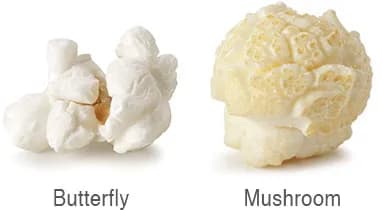
We have all eaten popcorn niblets, or corn on the cob. Turns out that doesn’t make popcorn. A particular species of maize called ‘Zea mays everta,’ is the only variety that pops. Though there are over 100 strains of this with different flavours. One strain produces the mushroom shaped popcorn, whilst another turns into the snowflake style, which tends to be the most popular for snacking.

Different Strains Of Popcorn

Is It Bad For You

It’s low in fat and high in fibre. Really it is a healthy snack. BUT, as soon as you start adding butter, caramel, sugar, salt and toffee it ceases being healthy. So you could keep it as a natural healthy snack, but where is the fun in that. It should be slathered in butter, and sugar. Or if you are American or just plain weird, salt.

Are Popcorns Carbs

Yep definitely are. Around 74g in every 100g in fact. So definitely high on the scale.

Will Popcorn Help You Poop

As a matter of fact it will, it is high in fibre so it can provide relief from constipation. And it sure as hell will be a lot more pleasant than a suppository.

Is It Harmful To Cats

Popcorn itself isn’t no, but some of the additives and toppings may be, so before sharing with your feline friends it would be wise to check with your vet. The unpopped kernels can be harmful to their teeth, or even pose a choking hazard.

Event Planning, Fun Story, funfair events, Funfair Rides

Orton, Sons and Spooner Ltd., A Manufacturer Profile

14 September 2021

The golden years of fairgrounds in the UK, pretty much the Victorian era really. Saw numerous home grown companies providing the ever expanding scene with rides and shows that were works of art. Sadly like much of British industry, few ride manufacturers still remain. The legendary names of old seem to limp along in various forms until about the last third of the 20th century before finally fading away. Orton, Sons and Spooner Ltd was one such name, responsible for some of the most ornate switchbacks, arks and shows ever to appear on the fairground, they ended as equipment handling manufacturers before ceasing to trade around 1977.

George Orton

Originally they were two separate companies. The first being the Lion Carriage Works. Set up by George Orton who manufactured gypsy wagons as well as drays and carriages for other industries. Based in Burton upon Trent, he received his first commision for a Showman’s wagon around 1883. At that period in history, showmen not only lived in their wagons, but they tended to be highly carved and ornate and formed the front part of a travelling show.

Charles Spooner

A young man named Charles Spooner, owner of the ‘Swan Works’, in Burton was one of Orton’s suppliers. A wood carver who had been apprenticed to Walter Gifford Hilton he supplied drays and carts to the thriving brewing industry in Burton.

Orton contracted him to provide carvings for his showfronts and wagons. This symbiotic relationship flourished to the point that the two companies were amalgamated in 1925 as Orton, Sons and Spooner Ltd.

Ride Manufacturing

They soon expanded their range into the full scale building of rides and showfronts and came to dominate the market. Their highly ornate, exquisitely decorated constructions were far in advance of the plainer, less impressive offerings from competitors, indeed the breathtaking scale of their offerings haven’t been matched since.

The picture above is a typical example taken from one of their scenic railways. Superbly detailed and robustly constructed, these cars were said to weigh around 1500kg’s each, with a complete ride in the 35-40 tonne bracket.

They built their first scenic for Holland Brothers in 1912, some 57 feet in diameter and powered by no fewer than eight electric motors. Over the next twenty years they completed over 30 of these rides.

World War I

The first World War, saw the company requisitioned to produce aircraft hangers, but successfully re launched into the fairground market in 1919 with another scenic railway.

Their final scenic was delivered in 1925, with the type coming to the end of its popularity. Smaller and lighter attractions now ruled the roost, with Noah’s Arks, Waltzers and Speedways being in demand. They also turned out an estimated 50 dodgem tracks, along with ghost trains, shows and side stalls. They built the first skid ride for the famous Midlands showman Pat Collins in 1928.

Sadly George Orton passed away at the age of 81 in 1924. The company now being in the hands of his sons, and Charles Spooner, who had married his daughter Anne.

From the onset the business employed only the best artisans and artists. The father and son teaming of Albert and Sid Howell being responsible for some of the stunning art gracing the fronts and rounding boards of these rides.

The Ben Hur front for Edwards ark was considered to be Sid Howells greatest work. The image above doesn’t do justice to the sheer size and scale of the work which was around 15ft high and over 40ft long.

Carving

Charles Spooner gained a reputation as being amongst the finest wood carvers in the business. Creating examples of pretty much everything required on rides at that time. The company was quick to respond to current affairs. Producing animals carved as Generals during the Boer war, and armoured cars and tanks during WWI.

They successfully transitioned from their early Rococo style creations, as the country moved into the Art Deco period. They produced modern, for the time, decor with curves and swooping forms. Decorated with modern airplanes and train engines, mixed in with bright colours and influences of the exotic from the far east and Egypt.

In common with much of industry, they gradually moved away from the one off hand crafted work. To a more standardised production line using stencils and patterned parts. To keep up with increased demand and competition this was a necessary evil. It did mean though that we would never again see the wonderful fronts and carvings for which they had become famous.

World War II

Charles Spooner died at the beginning of WWII. The bulk of the companies efforts being the manufacturing of military vehicles during the war.

They recommenced work in the fairground industry after the war. But it was a changed world, demand from the showmen was dropping off, and they began to diversify into other engineering work. 1954 marked the final break with fairground manufacture, and the company soldiered on until finally falling into receivership in 1977.

Orton, Sons and Spooner Ltd will be remembered as one of the greats of the last century.

Sources;

The Fairground heritage Trust

National Fairrgound Archive

Fun Story, Funfair Rides

Bradley & Kaye, A Manufacturer Profile

14 August 2021

Some of the ride manufacturers out there are universally known throughout the world. The big boys, Mack, KMG, Chance are all household names (well within funfair and amusement operators households).

Our name this week isn’t one we have heard much about. Possibly because it was folded into the Chance rides organisation in 1986.

Beverley Park

In 1945 Dave Bradley and Don Kaye purchased Beverley Park in Los Angeles from the Frock and Meyer Amusement Company. Aiming for the family market they filled the park with children’s rides, believing that the park should be spotless, and that the customers needed to look like they were enjoying themselves.

Dave Bradley was an economics graduate who held an impressive catalogue of career changes. He worked as a reporter, managed the big bands of Freddy Martin and Russ Morgan, worked as a production manager at a radio stations, and a toolmaker for Lockheed Martin.

The park is credited as the inspiration for Disneyland, with Disney and his daughters being regular visitors, indeed Dave Bradley assisted Walt Disney in the planning of the original Disneyland, travelling throughout Europe to photograph rides for him, and working as a consultant on the original Disneyland. Dave’s first wife Bernice had worked in the Disney Studios research department, before leaving to help run the park full time.

Throughout the 40’s, 50’s and 60’s most of the major Hollywood stars visited the park with their children, with Errol Flynn, Lana Turner and Carol Burnett being regulars.

Don Kaye decided to return to his roots in the music business, leaving the company in the hands of his partner, who decided to leave the name unchanged.

1947 saw the company designing a mini roller coaster for kids, called the little dipper. This was licensed to the Allan Herschell company, one of the countries biggest manufacturers. This was a portable ride which could be carried on a 20ft trailer.

The Red Baron

A popular aeroplane themed ride was introduced in 1972, being delivered to Opryland. Based on the WW1 German Ace pilot of that name, the rides were themed with red triplanes and on some white planes decorated up with the British Flying Corps roundel.

Dave Bradley realised at this point that a full time manufacturing facility was needed to keep pace with the orders they were receiving. this was set up in Long Beach California.

During the first half of the 70’s Bradley & Kaye built Red Barons, Jeep rides, Dark rides, stunt rides and more. The company seemed to quite happy with custom commissions, and introduced an innovative small coaster for Storeyland. Called the ‘Ice Berg Coaster’ it followed the contours of the land through the park, skimming across a lake, and dropping down a cliff.

One highly advanced ride the company came up with was the Barnstormer. Kind of like a modern starflyer, but instead of seats the riders were in aeroplanes, which circled 100ft off the ground. The advanced part was the ability of the planes to dive 50ft under the riders control. The ride only operated a few seasons, never quite agreeing with the winds encountered 100ft up.

Carousels

Dave Bradley was an acknowledged expert in Carousel working on this genre of ride as far back as 1951. He was employed by the great Alfred Hitchcock as an adviser for the carousel scene on the film ‘Strangers On A Train.’

Bradley took moulds from a number of classic carousel horses present on historic rides. He developed new fabrication methods and became highly regarded for these. Indeed this was one of the reasons that Chance Rides took over the company, to access this ‘stable’ of horse designs.

A log Flume was produced in 1978 for Hot Springs Arkansas. A1200 ft model with two lifts, based on an unusual chain lift mechanism, rather than the normal belts. They also produced a number of custom rides for Canada’s Wonderland, and dual swinging boats for Little England in Florida.

1986 saw the Bradley & Kaye draw to a close as it was taken over by the Chance Ride group. They wanted their elaborate collection of horse moulds, and another innovative name faded into relative obscurity.

Sources;

The Amusement Parkives

Hire Our Range Of Food Trucks

KCET