Tag: Fairground Ride

funfair events, Funfair Rides, Major Fairs

Tilburg Kermis, A Major Fair

23 March 2022

Another of our quick look at major fairs, a little different this time as it is in the Netherlands. Dating back to 1570, the Tilburg Kermis is the largest fair in the Benelux region, attracting over a million visitors annually which makes it big by any standard.

Playing host to upto 250 attractions spread over a 4.5km city centre site Tilburg is held around the third week in July. Like many fairs in the UK, it started as a market, being held to honour Tilburg’s patron saint. Unlike many UK based events though, the local community and businesses play an active part in the event. With local pubs and restaurants staging music events, large scale DJ sets and themed evenings. A stark contrast to the UK based scene, where many local businesses close for the duration of the fair.

Pink Monday

One of the most popular days of the fair, is Pink monday (Rose Maandag). Celebrating lgbt values, it brings gays and lesbians from across Europe, with many of the attractions sporting pink decor for the day. Attracting over 350,000 visitors this is a definite boost for the event. The slogan for the day is “Be Gay For A Day”

The event even has it’s own radio station. Kermis FM, offering a mix of information about the event, traffic data and kermis style music.

The final day of the Tilburg Kermis sees a massive procession towards the pius harbour. Culminating in a 15 minute firework display.

Resources: Kermis Tilburg Official Website

Event Planning, Fun Story, Funfair Rides

Sid Howell, Fairground Artists

21 September 2021

Another in our series of portraits on the great fairground artists. Sid Howell, and indeed his father Albert, were two highly regarded painters at the firm of Orton Sons, & Spooner. Or more commonly Orton & Spooner as it was referred to within the funfair industry.

The company produced some of the most ornate and elaborate rides, stalls and showfronts during the early part of the 20th Century. Indeed little since has come close to matching their style, both the early rococo theme or the later Art Deco. They were well known for employing the best of artisans and artists to work on their rides.

Sid Howell was born in 1906 in Bristol, but moved with the family to Burton On Trent, the homebase of Orton and Spooner. He not only studied art at school, but was helped with additional coaching from his father, and received actual working experience at the firm.

By the time he was 18, he had completed a study course at Burton Art School, and eventually qualified to teach the subject.

Many would assume that he would follow his father in to the amusement ride firm, but he chose a different path, instead accepting a position as trainee draughtsman at Branston Artificial Silk. Sadly this didn’t work out as the company folded three years later.

Orton Sons, And Spooner

When Sid found himself unemployed in a period where jobs were scarce, he ended up joining his father Albert decorating funfair attractions. He brought the benefits of a new younger generation to the company. His knowledge of new techniques and his introduction of newer styles was evident in the standard of work being turned out.

The father and son team were a perfect match, especially on the many jungle scenes they painted together.

They were interrupted during the war years, as were most ride manufacturers. But happily by 1946 the company was back producing rides.

Edwards Ben Hur

Robert Edwards owned a Noah’s Ark that had been built in the mid 30’s. He placed an order for the ride to be rebuilt.

The rounding boards were painted in the familiar jungle theme, quite probably by Albert. Sid however designed and painted a scene from Ben Hur on the main front panels. At over 40ft wide and 15ft tall it was a stunning work of art. This was widely recognised as the finest work of his career. Keep in mind that the front not only had to look right at ground level, but also when it was placed in the air. Add in the fact that the front was curved, and you have an idea of the level of skill involved in his creation.

Much of the fabulous artwork from these early artists has been lost, either when the rides were retired and scrapped, or when, as often happened they were repainted to keep them fresh.

Dingles

Happily the Ben Hur ark survived. It is now a resident at the Dingles Heritage Museum in West Devon. Well worth a trip out to see.

Sid eventually left Orton & Spooner as work from the showmen gradually dried up. The company turned away from the industry .

Sid had a spell undertaking freelance work, and worked at an amusement park, and also Blackpool’s famous illuminations.

He died in 1966, but the immensity of his talent lives on in his finest work.

His son, Alan S. Howell, researched and wrote a book about the artists of Orton & Spooner titled ‘Men At Work‘. This is fetching sums in excess of £100 for a paperback copy. It would be well worth a read if you can get your hands on one.


Resources;

Fairground Heritage Trust

Joyland Books

Event Planning, Fun Story, funfair events, Funfair Rides

Orton, Sons and Spooner Ltd., A Manufacturer Profile

14 September 2021

The golden years of fairgrounds in the UK, pretty much the Victorian era really. Saw numerous home grown companies providing the ever expanding scene with rides and shows that were works of art. Sadly like much of British industry, few ride manufacturers still remain. The legendary names of old seem to limp along in various forms until about the last third of the 20th century before finally fading away. Orton, Sons and Spooner Ltd was one such name, responsible for some of the most ornate switchbacks, arks and shows ever to appear on the fairground, they ended as equipment handling manufacturers before ceasing to trade around 1977.

George Orton

Originally they were two separate companies. The first being the Lion Carriage Works. Set up by George Orton who manufactured gypsy wagons as well as drays and carriages for other industries. Based in Burton upon Trent, he received his first commision for a Showman’s wagon around 1883. At that period in history, showmen not only lived in their wagons, but they tended to be highly carved and ornate and formed the front part of a travelling show.

Charles Spooner

A young man named Charles Spooner, owner of the ‘Swan Works’, in Burton was one of Orton’s suppliers. A wood carver who had been apprenticed to Walter Gifford Hilton he supplied drays and carts to the thriving brewing industry in Burton.

Orton contracted him to provide carvings for his showfronts and wagons. This symbiotic relationship flourished to the point that the two companies were amalgamated in 1925 as Orton, Sons and Spooner Ltd.

Ride Manufacturing

They soon expanded their range into the full scale building of rides and showfronts and came to dominate the market. Their highly ornate, exquisitely decorated constructions were far in advance of the plainer, less impressive offerings from competitors, indeed the breathtaking scale of their offerings haven’t been matched since.

The picture above is a typical example taken from one of their scenic railways. Superbly detailed and robustly constructed, these cars were said to weigh around 1500kg’s each, with a complete ride in the 35-40 tonne bracket.

They built their first scenic for Holland Brothers in 1912, some 57 feet in diameter and powered by no fewer than eight electric motors. Over the next twenty years they completed over 30 of these rides.

World War I

The first World War, saw the company requisitioned to produce aircraft hangers, but successfully re launched into the fairground market in 1919 with another scenic railway.

Their final scenic was delivered in 1925, with the type coming to the end of its popularity. Smaller and lighter attractions now ruled the roost, with Noah’s Arks, Waltzers and Speedways being in demand. They also turned out an estimated 50 dodgem tracks, along with ghost trains, shows and side stalls. They built the first skid ride for the famous Midlands showman Pat Collins in 1928.

Sadly George Orton passed away at the age of 81 in 1924. The company now being in the hands of his sons, and Charles Spooner, who had married his daughter Anne.

From the onset the business employed only the best artisans and artists. The father and son teaming of Albert and Sid Howell being responsible for some of the stunning art gracing the fronts and rounding boards of these rides.

The Ben Hur front for Edwards ark was considered to be Sid Howells greatest work. The image above doesn’t do justice to the sheer size and scale of the work which was around 15ft high and over 40ft long.

Carving

Charles Spooner gained a reputation as being amongst the finest wood carvers in the business. Creating examples of pretty much everything required on rides at that time. The company was quick to respond to current affairs. Producing animals carved as Generals during the Boer war, and armoured cars and tanks during WWI.

They successfully transitioned from their early Rococo style creations, as the country moved into the Art Deco period. They produced modern, for the time, decor with curves and swooping forms. Decorated with modern airplanes and train engines, mixed in with bright colours and influences of the exotic from the far east and Egypt.

In common with much of industry, they gradually moved away from the one off hand crafted work. To a more standardised production line using stencils and patterned parts. To keep up with increased demand and competition this was a necessary evil. It did mean though that we would never again see the wonderful fronts and carvings for which they had become famous.

World War II

Charles Spooner died at the beginning of WWII. The bulk of the companies efforts being the manufacturing of military vehicles during the war.

They recommenced work in the fairground industry after the war. But it was a changed world, demand from the showmen was dropping off, and they began to diversify into other engineering work. 1954 marked the final break with fairground manufacture, and the company soldiered on until finally falling into receivership in 1977.

Orton, Sons and Spooner Ltd will be remembered as one of the greats of the last century.

Sources;

The Fairground heritage Trust

National Fairrgound Archive

Event Planning, Fun Story, funfair events, Funfair Rides

The Waltzer, History Of An Iconic Ride

10 April 2021

One of the mainstays for any British funfair is the Waltzer. Indeed so popular is this particular ride that you will struggle to find any but the smallest funfairs without one.

Similar in style to the Noah’s Ark ride, i.e., a platform that rotates at high speed and undulates over a number of hills to give an up and down motion. The difference is the ark originally had various animals to sit on, then evolved to have motorbikes, probably around the time that motorbikes became popular with young people. This led in some places to them becoming more popularly known as speedways. As most early rides were these tended to be ornately decorated.

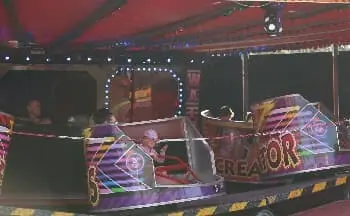
The waltzer by contrast has tub shaped cars, that are attached by either a slew ring or a pivot point to the platform. As the ride rotated, the riders all sat at one end of the car would unbalance it and it would begin to spin. The attendants on the ride would walk the platform as it rotated spinning the cars by hand to make them faster. With attractive young ladies tending to be spun the most.

Waltzer car
Waltzer car

Early History

The very first evidence we have for the ride, is a 1920’s model built by one Dennis Jeffries of Congleton. Posterity records the very first passengers as being his nieces Phyllis and Dolly Booth, nothing like using family as Guinee pigs. A tradition which continues today, a few years back a relative building his own ghost train had put the first car together, but wasn’t sure if the gearing was correct. He put his old dad in as a crash test dummy and set it in motion. The car accelerated along the track like an exocet missile, jumped the rails at the first corner and set off into infinity and beyond. Luckily said dad fell off at this point. No amount of cajoling could convince him to try the mark two car.

Maxwell And Sons

The sadly now defunct Scottish firm of Maxwell and Sons, based in Musselburgh, became perhaps the best known manufacturer of the ride in the UK producing some 59 examples of the ride. Waltzers tended to have ten cars, though as the ark/speedway fell out of fashion a number of these were converted to waltzers so there are both nine and eleven car examples.

H.P. Jacksons

The biggest rival to Maxwells was the Congleton based firm of Jackson’s who produced 29 rides. They kept going a little longer than Maxwells producing their last ride in 1992. (Maxwells were out of business by 1983)

A number of other firms produced waltzers, but only in very small numbers.

Fairtrade Services

Waltzers were always an extremely labour intensive ride to set up and derig. A handful of examples were converted to pack on an artic load to reduce the set up time. A showmen by the name of Robert Porter, who was experienced in refurbishing and repairing waltzers. Took this a step further with a design for a new ride, made from the start to be a more compact travel load and quicker set up.

Under the brand of Fairtrade Services he has now produced 21 examples. They are on track to surpass Jackson’s as the second most prolific manufacturer.

One particularly striking example of a ‘Porter Waltzer’ as they are more commonly referred to, is the example above. Built for the Norwegian firm of Lund’s Tivoli. With Aasmund Lund at the helm, the firm commissioned this ride. With it’s stunning fireball theme, around the back of the ride are numerous led screens that provide a fire effect.

It is unusual that although the ride is one of the most popular in the UK, it is seldom seen on the continent. Raymond Codona Jnr travelled his Hell Raiser waltzer in Holland for a number of seasons. Very successfully, but you find few native examples.

Tilt-A-Whirl

Across the pond Herbert Sellner invented a similar ride called the Tilt-A-Whirl in 1926. Similar in motion to the waltzer this type only has seven cars, but otherwise works in much the same way.

The most noticeable difference, is that the waltzer has a roof and is an enclosed ride. Add in the sound and lighting systems and they are much like a portable nighclub. The tilt a whirl by contrast is an open topped ride. To be honest looks very much like an home made waltzer.

The Waltzers

The waltzer is an enduring icon of the British fairground scene. One change to its detriment is are the current health and safety laws. Waltzers were renowned for having the gangway around the edge of the ride packed with people. It truly was a social event, with many a couple meeting on the waltzers (Kevin Keegan the England football star was one, meeting his wife on Dowses waltzer at Scunthorpe). Sadly young people nowadays aren’t considered responsible enough to stand on he gangway a few feet from the spinning platform so now the ride is closed off whilst it is in motion.

Sources;

Fairground Heritage

National Fairground and Circus Archive

Wikipedia Waltzers Originally Had 10 Cars

Event Planning, Fun Story, funfair events, Funfair Rides

Weird Carnival Rides, The Flying Cars

6 March 2021

Over the years there has been some way out and wacky rides designed for the funfair industry. Some have worked and became classics. Others were either too unreliable, vomit inducing or just downright dangerous. The flying cars could be argued to be dangerous as it did in fact kill someone. However the someone failed to fasten their safety belt so its an arguable case.

The ride was something quirky. The drum rotated and the cars were fixed to the track, similar to a roller coaster. The cars had a brake pedal which clamped the car to the track causing it to climb the drum. Once it had climbed you released the brake to allow it to fall back down and up the other side. Eventually you built enough momentum up to go 360 around the full drum.

The Ride In Action

Unfortunately someone failed to fasten their seatbelt and was killed in the fall which resulted in the ride being removed. Modern technology would probably solve that problem now with interlocked safety bars and the like.

There was records of a second, double drum flying cars ride being built for Conklin’s Carnivals, but scant records exist of that model or any other rides.

The ride was built by a German manufacturer, but despite the wonders of the world wide web, we have been unable to find out which particular one.