Author: Jarm69

Event Planning, Fun Story, funfair events, Funfair Rides, General

Eli Bridge, A Manufacturer Profile

28 February 2021

Next up in our ongoing series of amusement ride manufacturer profiles, is the long established American company of Eli Bridge.

The founder W.E. Sullivan visited the original Ferris Wheel at the Columbian Exposition in 1893. He (like George Washington Gale Ferris) owned a bridge building company. After his ride he became fascinated by the ride and decided to build one of his own. In collaboration with the machinist James H Clements they began construction of their own wheel.

This debuted in Jacksonville’s Central Park and was called the Big Eli Wheel. The ride was a success and Sullivan set up a company to manufacture his wheels.

Their first wheels were powered by 6h.p. huber steam engines and came in two sizes, 45ft portable models and 50ft park based designs. There was also a 55ft ‘Aristocrat’ model.

The company was originally located in Roodhouse, Illinois, next to a railway track, allowing for easy distribution around the country. In 1919 a new purpose built building was erected in Jacksonville, also next to the railroad. The company has been there ever since. It’s 76,000 sq ft facility contains a room tall enough to erect a big wheel in.

Modern Eli Bridge Wheels

The company still produces wheels to this day. A modern Eli Bridge, is, truth told, little changed from the earlier models. Sure, there is no doubt the construction will use moderner materials and methods. But the look and feel of the ride definitely contains the same DNA. That isn’t meant as a criticism. The fact is the early formula worked well, and still works well, so why change it?

One major change is the drive system. For generations, the wheel used a wire rope, that passed through a pulley which was rotated by an electric motor. The system worked fine, and still does as hundreds of wheels around the world continue its use. It did however have a couple of disadvantages. The rope gradually stretched, and as it did the drive began to slip. Murphy’s law would dictate this happened just as you got busy. The other failure was when the rope snapped. A sensible operator would keep a spare, and could change it relatively quickly, but it is still inconvenient and would lose you revenue.

Rim Drive

To counter the wire rope issues, the company has now switched to rim drive systems. This works by attaching a flat rim to one side of the ride. An electrically driven wheel would contact the rim and as it rotated, would rotate the ride. No slipping or snapping and a much more precise regulation of the speed available from a modern inverter driven control system.

Scrambler A New Chapter

1955 brought a new chapter for the company, with the launch of its Scrambler ride, the first non wheel addition to its portfolio. Known over here as a ‘Twist’ the ride took the American amusement industry by storm, and is still prevalent at funfairs around the world today, albeit in many versions from many different manufacturers.

Other Products

They also sell a couple of children’s rides, including the quirky Spider Mania, to which I can’t really find a comparable ride in the UK.

A line of fire pits for camping expeditions and Boy Scout troops round off the companies product list.

. One quirky fact is that the word Bridge was deliberately left in the company name, so that they could still build bridges, their original business model. Though records indicate that since they started selling wheels, they have only actually built one bridge.

Check out our profile of Fabbri the Italian manufacturer.

Catering, Event Planning, Fun Story, funfair events, Funfair Rides

Dismaland A Theme Park With A Difference

24 February 2021

The world renowned graffiti artist, Banks’y happens to be a favourite of my daughters. To be honest I quite like his style too. A few years back when she was studying art at school, she made Banksy her special project, so one day we jumped in the car and drove to Bristol to visit his artworks in the flesh so to speak.

When he announced the Dismaland project, a theme park not suitable for kids as he put it, at an old Lido in Weston Super Mere. We were lucky enough to secure tickets for us and a couple of Emmerson’s friends.

My wife hates using our car due to the size and fuel consumption, but none of the vans would fit 5 people, so I got to enjoy a blast all the way down the country in my Mas. During the periods the wife fell asleep I got to enjoy the 400+ horses under the bonnet without screams of “Look at the fuel consumption” lol.

When we got to the park, the queue was enormous. It was then that I realised a possible problem. I had actually bought the tickets on ebay, not through a regular channel as they were next to impossible to obtain. Basically the ticket was a sheet of A4 paper with a barcode. Anyone could have put them together, or the same ticket could have been sold multiple times.

Crap, but I did have a cunning plan, I sent the kids in first to see what happened. In the event they walked straight in so we were ok.

A Park With A Difference

Now the park itself was different, very different, but something we all enjoyed. However I have to say it brought a worrying trend home. The whole idea was that the park was meant to be a dismal, unfriendly place, with surly staff that couldn’t be bothered with the customers. A spoof on a traditional fairground.

Thing I realised was, the customer service part was pretty much what you see on some fairgrounds today. Young kids in the stalls playing on their phones who viewed you as a nuisance if you wanted to play. Operators in the rides looking bored and disinterested. At one point the wife and I were stood debating whether we should go into a particular structure. When the girl on the outside shouted at us “In or out, in or out, don’t stand there blocking the ride, make your mind up!”

I burst out laughing, because a very good friend of mine has exactly the same customer facing skills. I have seen her shout very similar commands when some poor unfortunate is stood at the ride entrance making their mind up.

I was impressed by the thought that had gone into the attractions. To be sure they were taking traditional funfair attractions and twisting them into some steam punk, distressed interpretation of what they would have been. But in some cases hitting the nail right on the head.

It’s Impossible To Win!

Take topple the anvil for instance. I should imagine its physically impossible to knock an anvil off the shelf with a rubber ball. But then, there are games I have seen on fairgrounds that are equally impossible. The traditional coconut shie was renowned for having ‘duds’, that is some of the coconuts you were trying to knock off were actually metal replicas. Nothing short of an Exocet missile would move them.

One of my favourite shows was death riding the dodgem car. Played to trance music it was one of the earlier attractions we encountered and was just plain funny.

There was plenty of Banksy’s political commentary, such as the coin operated remote control boats. Which happened to be boats filled with refugees. Or the exhibition of various weapons used by governments to oppress the people.

There were also some weird commentary on consumerism and minority representation such as the gifts below sold in the shop.

Battlefield Casualty Action Man

But The Food Was Good

Lol, even the catering didn’t escape his vitriol.

Although some people slated the park, I think it is because they just didn’t get the sarcasm mixed with social commentary undercurrent that it was put together with. We had a great time.

Sources;

Dismaland

Banksy

Fun Story, Funfair Rides, General

Power Generators And The Decline Of British Industry

20 February 2021

With funfairs being a travelling industry, it’s fairly obvious that rides and such like cannot be connected to a fixed electricity supply. The answer is portable generators.

In the very early days, these tended to be steam powered. The traction engines used to transport the rides could have the drive belts disconnected and switched to dynamo’s to provide the 110v direct current supply used at the time.

As things progressed, and diesel powered lorries took over from the steam engines. A similar system was put into place. The drive shaft from the gearbox to the driving axle on the vehicle could be disconnected. A pulley was then attached to the output of the gearbox and drive belts used to drive a dynamo. With progress, the power source slowly began to gravitate towards 240v alternating current, same as powers a house.

I am 50, and can just barely remember helping my dad ‘drop the shaft’. Basically this was disconnecting the propshaft, dropping it to the ground and connecting the drive belts, a ritual at every fairground.

The ultimate evolution was the switch to dedicated generators. A totally separate engine and alternator or dynamo, or sometimes both piggy backed. These tended to have a more regulated speed control designed to keep the engine running at optimum speed for power generation.

Gardner Engines

A British manufactured engine rapidly became a firm favourite to build power generators. Built by a Manchester based firm called L.Gardner & Sons.

Originally a sewing machine maker, they moved into gas engines around 1895, then into the new fangled diesel engines in 1903. Their initial engines tended to be for marine use. In 1929 they fitted an engine into a Lancia bus. This was such a success that they ended up introducing a new range titled LW, geared towards on road use.

Gradually they grew to provide power for many of the existing lorry manufacturers throughout the UK, and also licensed the design to Dutch manufacturer Kremhout, Belgian makers FN and Miesse and French manufacturers Bernard and Latil . A larger range was introduced to power diesel locomotives, and things were good for the company as they became the world’s leading exporter of diesel engines.

A number of things were noticeable about their designs. Their thermal efficiency (how much energy was converted to actual power output as opposed to heat) was a shade over 40%. To put this into perspective, state of the art computer controlled engines in the 2010’s managed to hit 43%, a mere 3% improvement over a design 80 years old, and currently around 50% is as good as it gets.

Legendary Reliability

The other stunning achievement was the unparalleled reliability. A huge number of Gardner’s are still in use around the globe. From powering junks in Hong Kong harbour, to fishing boats in the 3rd world, to lorries in Africa. The marquee became a byword for long lasting trouble free use. In part the formula of a large engine working lightly meant the components were all relatively unstressed whether it was being used for a power generator, a locomotive or road going power..

The crankshaft also benefited from not only being secured vertically, as was normal, but also being horizontally braced. This gave the bottom end of the engine tremendous strength, and warranty claims for failure in this area were virtually unheard of.

Fall Of A Legend

Sadly, like many industries in the UK, Gardner’s were doomed to a decline and eventual demise. During the 70’s other manufacturers gradually increased the power output of their offerings. Gardner, controlled by Hugh Gardner stubbornly refused to follow. Whilst virtually every other manufacturer was adding turbochargers to provide more oomph, Hugh insisted on keeping his engines naturally aspirated. As gross weights steadily increased, more power was needed, and Gardner just couldn’t keep up.

When they eventually developed a turbocharged range it was too little too late. Cummins Engines of America were selling a 10 litre engine outputting 325 horse power. Gardners closest option was the massive 15.6 litre LYT that managed 350 HP, but had the inherent drawbacks of an engine of that size being heavier and thirstier on fuel, the opposite of Gardner’s traditional strengths..

Adding to the typical stunningly poor decision making of British upper management, the offer to take over Rolls Royce engine division to broaden their portfolio was turned down. Additionally they reached a point where there was a 2 year waiting list for engines to be supplied for new lorries. Perhaps an agreement with another manufacturer to licence build them could have alleviated this. Whatever the main cause, eventually they just lost too much sales volume and with the advent of Euro 1 emissions regulations they were closed down.

Unlike many former industries where the the British used to lead and then become basically extinct in that industry. Power generators are still being built by Perkins Engines.

Midget Submarines

One novel use of the Gardner engine, was the smaller 4LK model. Fitted into the Royal Navy’s X-class midget submarines. These were used to cripple the German battleship Tirpitz.

Some of the main Power Generator Manufacturers are;

Cummins

Caterpillar

Generac

Event Planning, Fun Story, funfair events, Funfair Rides

Some Common Funfair Questions

16 February 2021

One thing that the funfair industry is very poor at, is PR. Possibly because we tend to keep outsiders at arms length, many people have very little idea of how the industry works. Often we are regarded as gypsies (we are not, they are a totally separate ethnic/cultural group), there is this idea that funfairs just roll up willy nilly and set up on a piece of land they have no right to. That rides are thrown together by semi literate knuckle grabbing high school drop outs who have no idea what they are doing. So in an effort to spread a little fact, to counter some of the common fiction, we are going to answer some common funfair questions. If you have any others add them in the comment section and we will answer them for you.

1 Are Funfair Rides Safe?

This is the big one, and one that quite rightly you are entitled to ask. I will let the Health and Safety Executive provide the primary answer to this;

1.2 Risks to the public at fairs and amusement parks have proved to be quite small, on average, despite common perceptions to the contrary. For example, the risk of death from a typical session is estimated, on a pessimistic basis, at 1 in 83 million, which is:
a) about one twelfth that from a typical walk to get to the site;

Lets compare that 1 in 83 million figure.

Your risks of dying from the following pursuits;

  • Car Accident – 1 in 200
  • Train Crash – 1 in 65,000
  • Shark Attack – 1 in 3.7 million
  • Plane Crash – 1 in 7.6 million
  • Struck by Lightning – 1 in 14 million

So does this mean that the experience is totally risk free. Sadly not. Modern rides are high speed complex pieces of machinery subject to immense stress and high G forces. Modern computerised design and testing systems mean that much of the dangers have been designed out. However over time, metal corrodes and weakens, systems can fail. So how is this counteracted.

ADIPS

The ADIPS scheme requires a comprehensive safety test every year for each piece of equipment. This covers electrical and mechanical safety, as well as non destructive testing such as x-rays or dye penetration to check for cracks and metal fatigue. Rides are also required to have a daily check scheme in place which is recorded every day.

The weakest link, as always, are humans. Checks rely on the operator carrying them out and taking action on faults that are found. Most rides are operated by the families that own them, so the incentive to carry these out correctly is not only possible large fines and/or jail, but also the massive loss of income if they are closed down.

The Human Factor

The one factor we don’t have control over, are the actions of our customers, more humans. In my 50 years on the funfair I have only ever been at a fair once where someone was sadly killed. What happened was that a young man climbed over a 6ft high safety rail to go and push his friends on a ride called the swinging gyms. Basically a box containing 4 of his friends, you rock the box back and forth to gradually gain height and go over the top.

He ran to give them a push, tripped and landed on the bottom of the ride, as the box came down it crushed him. Totally tragic, and totally avoidable by the poor victim. But it is hard to see what more the operator could have been expected to do.

Similarly we regularly have arguments on rides with minimum height limits. Parents want their offspring to go on the ride but they are not tall enough. Enraged they demand that they are allowed on because the parent knows best and evidently wants to willingly put their little darlings at risk!

2 Do They Carry Insurance?

Yes, two types. The first covers the actual equipment for damage or loss from theft/fire/accident. A typical modern ride easily costs in the mid six figure bracket. A few examples are in the millions bracket, so it isn’t feasible to chance losing investments on this level.

The other is public liability insurance, covering the riders and members of public. Most rides have two policies, the first carries £1 million cover. We than pay into a trade organisation fund which adds an additional £10 million to this.

Most local authorities require a minimum of £5 million, so our industry is well in excess of what is required.

3 Do Fairgrounds Just Set Up Anywhere?

Another really popular misconception. We have set up in high streets in the past, only to have a local resident actually call the council to ‘make them aware’ that the high street is ‘under occupation’ by the fair folk.

At the minute (2021) things are still a little strange what with Covid and all. Normally, on January 1st, we could usually list the dates and locations of all our events for that year. Indeed some like Nottingham Goose Fair, have been operating for hundreds of years.

Look, a large funfair is a major logistical exercise. To move dozens of ultra large vehicles around the country to set up an event easily costs tens of thousands of pounds. Realistically, is anyone going to throw that kind of money about in the hope that when they set up the council and police will allow them to stay. An expensive mistake if they don’t.

Additionally the event needs to be advertised, additional logistics like filling generator fuel tanks, or providing a suitable locations for the living quarters all need to be arranged.

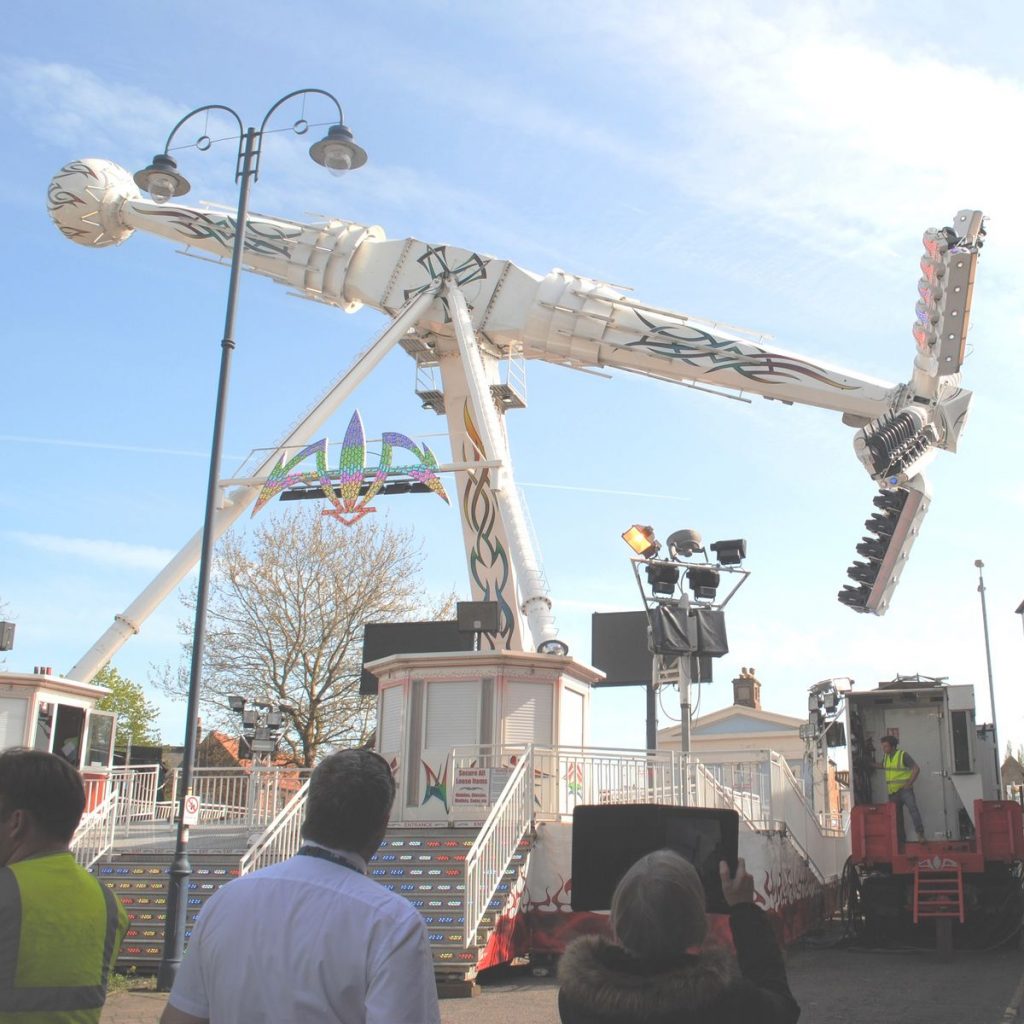
Take a look at the picture below, there is no way something like that can just be randomly thrown together, that is planned months in advance.

4 Why Are Fairground Workers Covered In Tattoos And Have No Teeth?

Lol, I just love some of the funfair questions we are subject to. The funfair community is an incredibly close knit one. Most of us either know each other, or at the very least are only a couple of steps away from knowing each other.

I know of only one ‘funfair operator’ who has tattoos. A really nice lad, he wasn’t actually brought up on the fairground but married into it. That’s it. Tattoos just aren’t considered a socially acceptable thing within the industry.

‘Ah’, I hear you cry, Mark off the waltzers who I was snogging has them. Well, yep, Mark probably does. Thing is, Mark is a local lad that has been employed casually to help out at your local fair. Next week he will go back to being unemployed Mark.

We don’t have a particular problem with the practise, it’s just not one we engage with as a rule.

A noted exception has to be mentioned though, a few generations ago, when times were particularly hard, one lady struggling to feed her kids, actually had her entire body, sans her neck face and hands, tattooed. She went on to appear as the main exhibit in her own sideshow.

The pain must have been incredible, they were a hardy breed back then.

Regarding the teeth thing, we actually do visit dentists, and I can’t honestly say that funfair dentition is any different to non funfair dentition.

5 Do You Have Things Like Running Water And Electricity?

Out of the many funfair questions we get asked, these ones really do bug us. No we eat cold food, don’t wash and go to bed when it gets dark. Or at least some seem to believe so. Pictured below is the interior of a modern caravan. Fully furnished and connected to electricity, gas and running water. Oh, and flushing toilets, probably the same make as in your house.

Gas, it probably slightly different as we tend to use bottled gas or LPG, rather than a fixed connection, which tends to be difficult with all the moving about and such.

Storage space tends to be built into sofa’s and various nooks and crannys as well as the cupboards and wardrobes. The end result is quite often more room and storage available than a typical modern house. Most caravan’s have entire sections that slide out to make the actual home much bigger than it is when being transported by road.

I remember a few years back in Holland, actually seeing a double deck caravan, IE it had a top floor, though that doesn’t seemed to have made it to these shores yet.

If there are any others you know of leave a comment and we will add to the answers.

Fun Story

St Valentines Day Customs Around The World

14 February 2021

14th February, St Valentines day, the day for lovers, young and old, chocolate and roses and cheesy cards.

Reputed to have begun in ancient Rome around 496AD with the festival of Lupercalia held in mid February. Girls and boys drew names from a box and would become girlfriend and boyfriend for the duration of the festival.

Of course the church hijacked it later on, and used it to celebrate St Valentine. A Roman Priest executed for refusing to deny Christ and associated with courtly love.

Being UK based we usually think of a dozen red roses and chocolates or champagne. Along with a card extolling our feelings of love. But how do other countries celebrate it?

Japan

Being Japanese, they tend to complicate it as usual. On the 14th girls give chocolates. However they do this in two ways. The first is called giri-choco and are pre made chocolates. These will be given to friends, family, perhaps work colleagues. Men they don’t love romantically. The second type are Honmei-choco, being either more expensive, or traditionally hand made by the girl. Given to their partners, boyfriends, lovers etc.

Traditionally men would only accept these from girl they were interested in.

On 14th March the menfolk would return the gesture three fold on what is called white day.

South Korea

The south Koreans, follow pretty much the same pattern as the Japanese. However, on the month after white day, they have an additional celebration called Black day. This is for all those unfortunate enough not to have received gifts on the other days. They get together and eat black noodles.

Philippines

The Filipino’s celebrate in much the same ways as in the West. However, there is also an added incentive for lovers on the 14th. Many municipalities provide free weddings on the day. The cakes, flowers, venue, banquet and even the rings are all provided free of charge. This leads to mass weddings around the country on St Valentines day.

Norway

Or Valentinsdag in Norwegian. Much like the UK, with meals, roses, lingerie and so on. They do have one old belief that birds mated on this day to bear their offspring. And it’s now believed that seeing birds mate is a sign of true love. TBH I don’t think I have ever seen birds mating. In fact I am not sure I would recognise what they were doing if I did, assuming the tradition refers to the feathered kind.

Sweden

Alla hjärtans dag, or All Hearts Day as our Swedish cousins refer to it. They prefer jellied candies and pastries to our traditional chocolates. It has only been an occasion in Sweden since the 60’s, so it isn’t as widely celebrated as in other countries.

Denmark

Our Danish friends have a tradition called Gækkebreve , or Snowdrop letter. They send the object of the affection a letter, but sign it with a series of dots for their name. The receiver must try and work out who it is from, and if they get it correct are rewarded with an Easter egg on Easter Sunday.

France

Hmm, an unusual custom and not exactly the height of chivalry. French singletons would call out to each other across the street to be paired up. But if the mane didn’t quite fancy the woman he was allowed to reject her and try again. The sadly outed woman would gather together to burn photos and other reminders of the suitors who had given them the thumbs down, as a sort of group ‘therapy’. Eventually the government banned the practise. No doubt some woman felt better burning the real item rather than the photo.

This early form of speed dating was christened “une loterie d’amour”, the lottery of love.

Wales

The Welsh evidentially, don’t traditionally go in for St Valentine. Their nearest version is Saint Dwynwen’s day on 25th January. Here the men present a gift of a wooden spoon to their love interest. Various symbols and patterns with special meanings were carved into the spoon. A strange custom when presenting a wooden spoon elsewhere usually has negative connotations.

Argentina

Those randy Latinos can’t manage with just the one day. They drag it out a whole week, starting on 13th and running to the 20th, sweetness week encourages the swapping of kisses for candy. The week ends with friendship day so no one is left out.

South Africa

The Springboks mirror the UK with a lot of the Valentine celebrations. However they do also follow in the footsteps of the original Roman celebration by pinning the names of their lovers on to their sleeves. Luckily they don’t follow the original rules to closely, as the Romans would sacrifice goats, then run through the streets naked, whipping the women folk to increase their fertility.

Most of the countries around the world have adopted the Western celebration of St Valentines day, with flower giving, chocolate and other gifts. Some Islamic countries are rather hostile to the holiday, and some outright ban it.

If you want a Valentine treat for your staff, a party or even as a private service for your loved one, many of our treats such as Churros, Valentine crepes, doughnuts can be made with a pink dough to suit the occasion, or we can supply melted pink chocolate as a topping.